
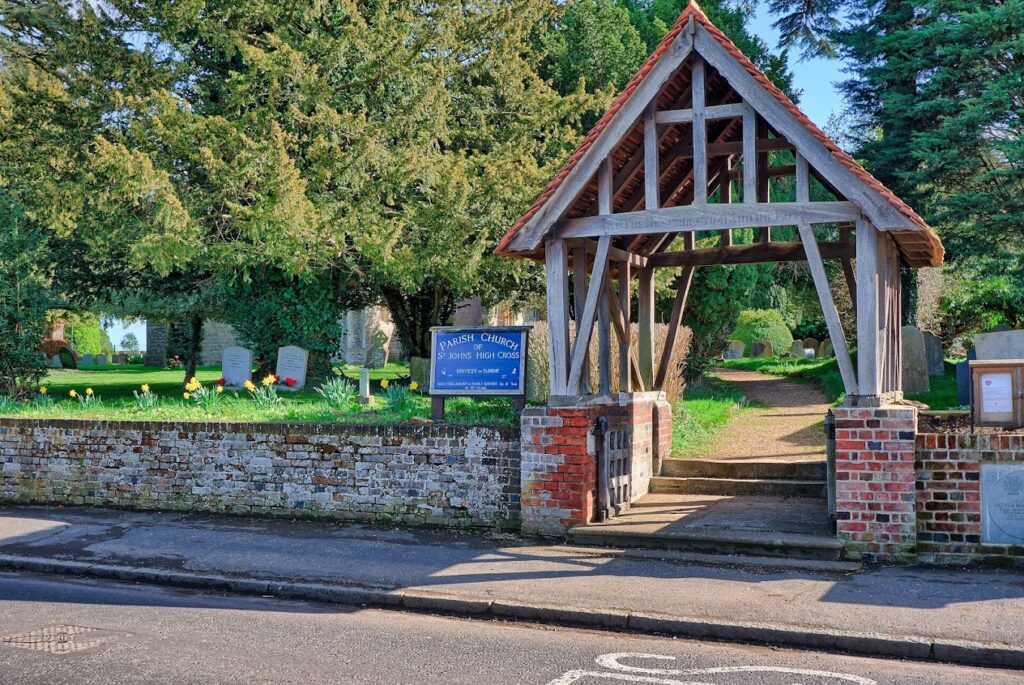

I can’t be the only one who has arrived at a picturesque old church and seen that they have a fine lychgate at the entrance to the church grounds. I’ve admired the woodwork and then wandered through the gate and not thought about why the church has a lychgate – surely it’s just a nice decorative archway and a great focal point for photographs?
It’s useful to note that lychgate can also be spelt lytch gate or lych gate and it gets its name from the medieval English; lyche meaning “body or corpse” and yate meaning “gate”. It may come as a surprise to learn that lychgates, constructed with a roof and generous in width, actually had a purpose and the clue is in the name.


Lychgates, also known as resurrection gates, date from the medieval ages before there were mortuaries. They mark the division between consecrated and unconsecrated ground. In some parts of England, it was the place to where corpse bearers carried the body of a deceased person and laid it on the parish bier; in other parts of the country the parish bier was wheeled to the deceased’s home to collect the body and then taken to the lychgate. The body would be left on the bier until the funeral service. Often one or more bearer stayed with the body overnight or for a couple of days, until the funeral service, to prevent body snatchers stealing the corpse. So, it was important that the interior of the lychgate was big enough to shelter a bier and several people, which is why some lychgates have small stone or wooden benches on either side of the passageway. It would be at the lychgate that the priest would carry out the first part of the burial ceremony.
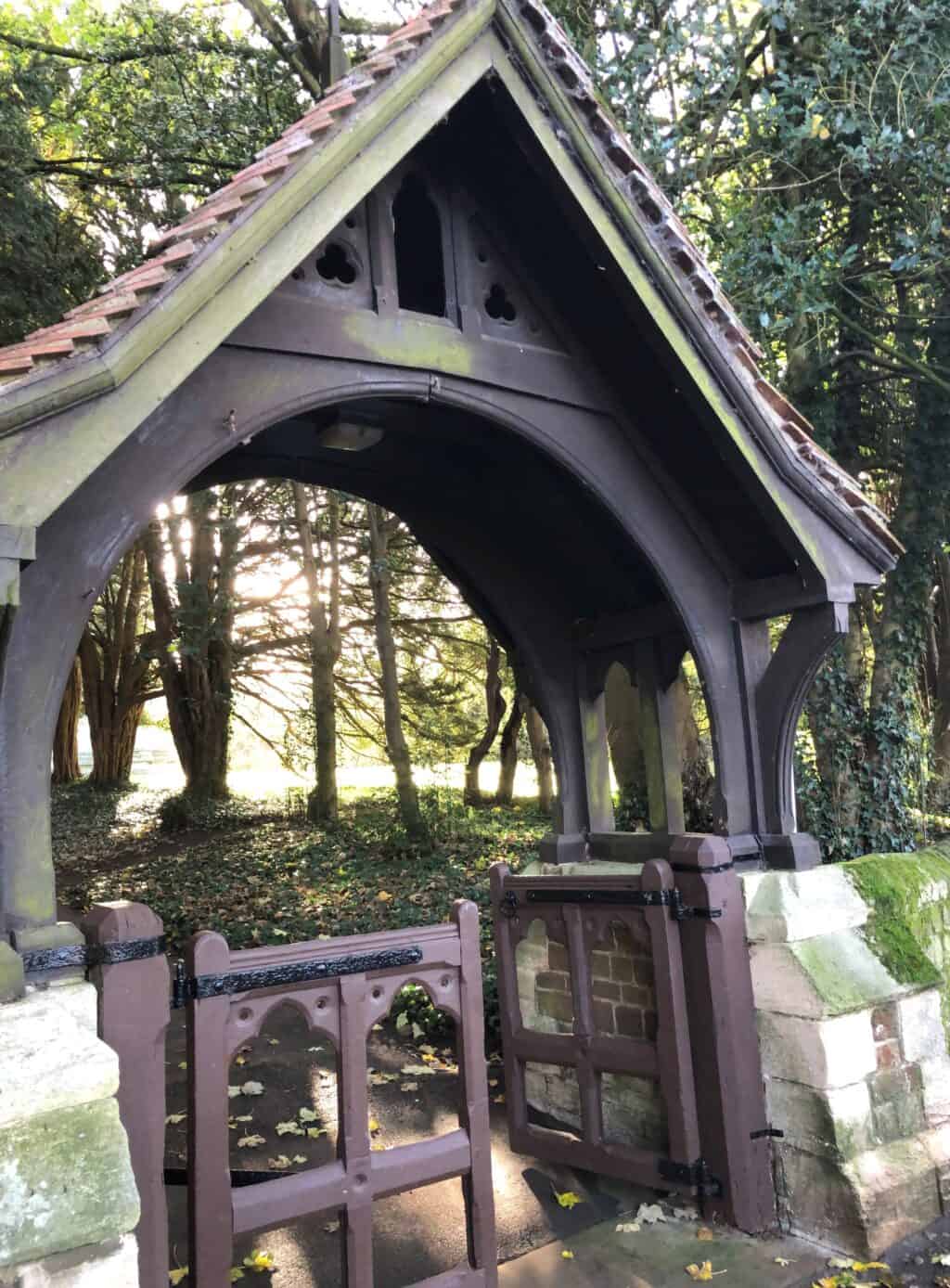
Its thought that lychgates have existed since the 7th Century but the majority that still exist were probably built during the 14th and 15th Centuries. The oldest surviving lychgate is claimed to be the one at St George’s churchyard in Beckenham, South London, dating from the 13th Century which was restored in 1924. The earliest lychgates were entirely constructed of wood, with two gabled ends, exposed to the elements and very likely to quickly decay. Gradually over time bricks walls replace wooden walls, and the wooden roofs sometimes replaced with clay tiles or thatch. Very few lychgates survive in their original state. The large timber beams framing the gateway are often carved with decorative features, a phrase or inscribed with the names of people.

During the Middle Ages, most people would have been buried in a shroud (a length of linen or woollen cloth that would be tightly wrapped around the body) instead of a coffin. Some parishes had a communal coffin to place the corpse in while it lay on the bier and then taken out before burial so the coffin could be used again. Until the late 1700s only a few wealthy people would have their own coffin to be buried in. The Burying in Woollen Acts of Parliament (1666–80) made it compulsory for English woollen shrouds to be used for burials (except plague victims and the very poor) instead of using foreign made textiles. The intention was to support the English woollen trade and the Acts made it a legal requirement that a member of the deceased family or a family friend had to swear in front of a Justice of the Peace confirming that the deceased had been buried in a woollen shroud. A fine of £5 would be made if it was discovered that a corpse had not been correctly shrouded. It is interesting to note that £5 in 1680 is equivalent to £572.25 in 2017 (National Archives Currency Converter).
Understandably this was not popular especially with the poor. It’s not known how strictly the law was followed especially in remote parishes, but historians agree that after 1770 it was universally ignored across England. The Act itself wasn’t repealed until 1814. Anyone researching church registers dating from the late 17th Century up to the early 19th Century may come across burial records with entries marked as ‘affidavit’ or ‘naked’ to indicate that either the deceased had been buried in a woollen shroud (affidavit) or was too poor to afford one (naked) and presumably buried in a linen shroud instead.
The act of placing a corpse on a bier within a lychgate before a funeral declined during the 18th Century and many of these gateways were left to decay or were dismantled and repurposed elsewhere.
During the 19th Century, especially during the Victorian period, lychgates were repaired or rebuilt not to accommodate the dead but as memorials to prominent or wealthy locals. The lychgate to the old churchyard at Widford was donated by the Hammond family, members of which had served as Rectors during the late 18th and 19th Centuries. The lychgate at Flitwick was erected in 1901, in memory of the three sons of the Reverend and Mrs Francis Ashpitel. After World War 1 new lychgates were erected as war memorials. The lychgate at Sandridge was unveiled and dedicated in a ceremony on Sunday 24 April 1921. It commemorates those from the parish who lost their lives in World War 1 and remembers those who fought in the war and returned home. It now also commemorates those members of the parish who lost their lives fighting in World War 2. Widford’s lychgate that opens to the ‘new’ churchyard was erected as a memorial to the men of the parish who died during World War 1; an oak panel was added later in memory of those who died in World War 2.


Lychgates not only played an important role in the life of the church, they have a very emotive place at the heart of any community’s history.
There are many churches within the Diocese that have lychgates. Hertfordshire’s are listed here: Category:Lychgates in Hertfordshire – Wikimedia Commons and Bedfordshire’s here: Category:Lychgates in Bedfordshire – Wikimedia Commons
Unfortunately, we don’t have many photographs of the lychgates! Feel free to send me photographs of your church’s lychgate and any information you have about it. Please however be careful if your lychgate is on a main road and you are attempting to photograph it, there are very few biers remaining within the Diocese that can still be used!

News from the DAC team
The DAC is here to support you to care for and develop your church buildings and churchyards, and to help you through the permissions processes