A call to action
Climate change is creating extreme weather, damaging the earth and destroying the lives of people around the world. It is caused by burning fossil fuels for energy and other human actions which produce greenhouse gases including carbon dioxide that trap heat in the atmosphere. We must reduce and stop the harm we are doing before it is too late.
The Church of England has the ambitious target of making major strides towards reducing our overall carbon production to zero by 2030. We all have a part to play in ‘turning the ship around’ and caring for and renewing our precious planet and the wonderful life it support. Parishes should aim to use energy efficiently and reduce the carbon produced by their church buildings while meeting the needs of the people who use them. They should look to make changes which are practical, worthwhile and can be afforded. This approach follows the DAC’s Strategy for Net Zero Carbon.
For more information about the call to action and to consider other areas of the environment, such as biodiversity and Eco Church, see the other Environment pages.
Energy Footprint Tool (EFT)
To get started with reducing your carbon footprint, it is important to know what it is in the first place. The Energy Footprint Tool is there to help you do that, as well as helping us and the Church of England get a better picture of energy use across all our churches.
We will be collecting your 2025 energy footprint data through the national church’s Parish Returns system, and it is open until 30 June 2026. Your incumbents have been contacted so they can enable the correct user accounts to be set up.
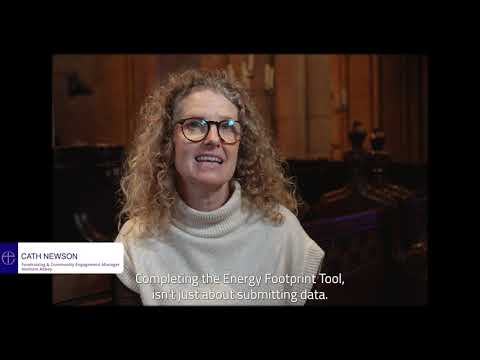
How and why should I complete the EFT?
Work out your church’s carbon footprint to help care for God’s creation
The Church of England’s Energy Footprint Tool is now open for churches to enter fuel and energy use from 2025.
The data collected from the tool will help your church, the diocese, and the national church to better understand all of our carbon footprints so that we can target our resources. Completion of the EFT is a requirement for several different grant funding streams that your church (or hall) may be able to access to reduce your carbon emissions and hopefully make your church more comfortable, efficient and affordable to run, whether through Quick Wins, or more substantial interventions such as replacing your fossil fuel powered heating system with an electric alternative. (Diocesan Net Zero Carbon Grants – The Diocese of St Albans)
This work is an essential part of caring for God’s Creation, by helping to combat global heating and climate change.
The easy-to-use online tool will tell your church what your carbon footprint is, based on the energy you use to heat and light your buildings.
What do I have to do?
Simply enter your church’s energy figures from the year before. Once you have entered all the data, you will immediately receive a report and results on your computer or smartphone. This includes:
- The church’s carbon footprint in CO2e (carbon dioxide equivalent)
- A simple assessment of your buildings’ efficiency, in graphical form
What do I need to get started?
You will need your utility bills for the year before: electricity, gas, oil, or whichever other fuel you use. For example, if you are completing it in 2026, you need your 2025 bills. If you have solar panels, find information on their generation over the preceding year. You can see the main questions you will be asked here in last year’s form: EFT Paper Questions 2025.
If you have a separate church hall you will need to add this building, and enter the bills for this too. If you want to exclude an area which is permanently rented out to tenants and sub-metered, you will want this information to hand.
The system is open until 30 June 2026 and you can find it on the online Parish Returns system
The Diocese of Portsmouth have put together a short walkthrough of how to fill out the Energy Footprint Tool on YouTube, available here
How do I access the tool?
Complete the EFT Now:
- Just go to Parish Returns and login.
- If you wish to see the questions (less than before) before you complete the form then they can be accessed from the bottom left quadrant of the first page. If not, then click ‘Enter your data’.
- On the next page pick your church, and then in the ‘Energy Footprint Tool’ section click ‘Enter your data’.
- Pick the buildings you wish to enter data for, and then click ‘Start EFT Return(s)’
- Complete the forms, and press the ‘Next’ button at the bottom of each page.
- At the end of the forms please click ‘Submit’ to ensure the data is entered in to the system (you can unsubmit later if you wish to change anything).
- You will then be provided with a calculation of your churches carbon footprint, along with the answers you submitted, and links to further information and guidance.
Heating/Renewables
Heating a church building is the main area of energy use in a church building. Exploring the options for replacement of a gas- or oil-fired boiler is an important step in working towards the Church of England’s Net Zero Carbon target.
The Church Buildings Council’s Heating Principles guidance
Heating church buildings can be a challenge: most churches are large, open and tall spaces with single-glazed windows. There is no universal system of heating appropriate for all churches but there are options available and there is alternative technology which could heat your church as required. In some cases, the costs of the alternative could be prohibitive at this stage but it could be that a change of system is not much more than the cost of replacing a commercial boiler system.
Along with the advice below, there are lots of resources to help you to learn more about what is available and how it could work in a church setting. The Heating and Renewables page has pulled these together into one place. Please use the link below to find DAC heating advice leaflets and templates.
How can the DAC help?
The DAC’s volunteer members and technical advisers can also help by discussing options informally on site and by reviewing specific proposals, as part of the more formal process leading to permission for changes to an existing system or for a new heating system. However, the DAC is not able to produce a specification for an individual parish – this needs to be done by a heating consultant or contractor commissioned by the PCC.
The DAC will review applications and, under the legislation from July 2022, needs to make a statement to the Chancellor showing how you have had regard to the relevant guidance from the Church Buildings Council. You will, therefore, need to make it clear in the application that the PCC has considered and responded to the CBC’s guidance. We have provided a template for a supporting document for heating applications to help you demonstrate that you have had due regard to the relevant advice, which is available on the Heating Advice Leaflets and Templates page .
What do I need to consider when thinking about heating my church?
Usage
If you have a busy town-centre church used regularly throughout the week for services, groups and events, then it makes sense to heat the fabric of the building and the regular use of the church may make this affordable. If you have a rural church used for Sunday and midweek worship and occasional events, it may be more appropriate – and more affordable – to aim just to provide instant heat for the people. It is also worth thinking about future use of the building. Do you have plans for increased community use? Equally, do you have a hall which is easier to heat? Would it be better to move some activities to the hall so you can look at other types of heating for the church?
Wants and needs
It is important to consider what your church users expect and desire from heating. In some places, it is acceptable for people to keep their coats on throughout services. In others, feeling warm and comfortable is a priority, so make sure that you have discussions about expectations and requirements.
Constraints
There will likely be some constraints preventing you from considering certain options. For example, it may be that you have an oil boiler because your village is not on the gas grid. The option of replacing your oil boiler for more energy efficient gas boiler is not an option, so you will have to look at the options for electric heating. The majority of electric options will require a three-phase electricity supply which could be a further constraint to negotiate.
Fabric of the building
Ensuring that you keep up with maintenance and repair of your church will help reduce the requirements of your heating system. Damp and draughts make people feel uncomfortable and cold, even if you are reaching the desired air temperature in the building.
Involving professionals
You should discuss what you want to achieve with your church architect or surveyor, who will be able to advise on the way the heating interacts with the building and your use of it and any opportunities or limitations arising from that interaction.
Some parishes engage a heating consultant, in which case you should ensure the consultant has particular experience of heating systems in the type of church building you have. You should provide the heating consultant with a clear brief about how you use the church, the types of system you are considering and constraints (e.g. budget, condition of existing pipework, timescale, etc). The heating consultant should provide a written assessment of options with outline costings for the PCC to consider and a specification with drawings as a basis for obtaining comparable quotations.
Heating consultants and contractors should be members of a professional body and the
following organisations may be useful:
Association of Consulting Engineers (ACE)
Chartered Institution of Building Services Engineers (CIBSE)
Building Engineering Services Association (BESA)
Institute of Workplace and Facilities Management (IWFM)
Depending on the proposal, it may be appropriate for a heating contractor to design and install a system. If this is the case, it’s vital that the chosen contractor understands the complexities of designing heating in a church – especially if reusing some existing equipment – so the DAC and Church Buildings Council advise:
- all contractors employed to work on wet heating systems in churches must hold a minimum qualification of Level 3 NVQ Diploma in Heating and Ventilating Industrial and Commercial Installations (City & Guilds 6188-30, or equivalent) and non-domestic qualification from Gas Safe or, for oil systems, be an OFTEC Approved Technician.
- Any work to a gas fitting must be carried out by a person who is registered on the Gas Safe Register (or is a member of another class of persons approved by the Health and Safety Executive for the purposes of Regulation 3(3) of the Gas Safety (Installation and Use) Regulations 1998).
- Any work to an electrical installation or electrical equipment must be carried out by a person whose work is currently subject to an accredited certification scheme for work in non-domestic buildings (e.g. NICEIC Approved Contractor).
What sort of system?
You need to think about both the heating system and the heat source. The Resource Centre page will help you to find advice and support about the types of systems and energy sources available, so we will not go into detail about any of these systems here, but it is helpful to have an idea about what types of system and technology is out there:
Electric systems
Direct electric systems aim to heat the people, rather than the space. They can include underpew heaters, heat cushions and near infrared heaters. If your church is currently heated by a wet system, this would be a significant change of approach but it could result in people feeling warmer and saving money because the church can be heated only when in use. There are lots of other types of electric systems which can be used, so it is worth looking around and getting some professional advice.
Wet systems
Gas and oil boilers usually se a wet system which usually aims to heat the space. It can be possible to reuse the heat emitters (i.e. the radiators, fan convector units etc.) with a renewable heat source but you will require some professional advice to identify if any repairs are needed – especially for older systems – and to see if they are compatible with the new source. A heat exchanger is sometimes required. If major work is needed or a large reordering project is planned, then it is well worth considering an underfloor system which gets heat to where it is most needed. In traditionally-built churches, any system must be permeable, e.g. using lime-based materials or keeping the vented floor void, and an archaeological assessment should be carried out at an early stage.
Boiler types/energy sources
Ideally, you should now be looking to see if it is possible to move away from fossil fuels, such as a gas- or oil-fired boiler. An alternative ‘green’ fuel is biomass but it requires large-capacity storage and volunteers to fill the burner. It is also possible that clean air programmes would prevent biomass from being an option.
Alternatively, you could consider installing an air or ground source heat pump. These require different levels of intervention but a well-designed system can provide 1.5-4kW heat output per 1kW of energy input, so they are incredibly efficient. They can and have been used well in church buildings so there are lots of case studies and advice (included in the Resource Centre) available to help you look at this further.
Help! Our boiler has just broken down! What do we do?
For any church, the heating breaking – especially in autumn or winter – can be incredibly difficult and disrupt services and events. The obvious thing to do has usually been to replace like-for-like but a change to the Faculty Rules in July 2022 to support the Church of England’s Net Zero Carbon target and our responsibility to care for God’s creation means that the immediate reaction and next steps need to be well considered. A full Faculty is now required in order for you to replace a boiler fired by gas or oil, so here we set out the steps you need to take and what documentation you need to provide to the DAC to support any application:
- Let the DAC Team know so we can provide any additional advice and support
- Check whether the boiler can be repaired, even if this is only a temporary solution to buy you time to consider non-fossil fuel options
- Manage expectations – it will not be as simple as getting a heating engineer to install a new boiler before next Sunday. For the short-term, you could:
- Bring forward any evening services so that it is not cold
- Publicise the need to wrap up warmly or even offer blankets
- If your electricity supply allows, use temporary electric heaters
- Move major services or events to another church in the benefice (following discussion with the Archdeacon)
- Offer a streamed service option for those who are vulnerable
- If all else fails, ask the Bishop for permission to move services into a hall or another location
- You will need to think about:
- Whether the pipework, pumps and other parts of the system are in good working order – otherwise adding a new boiler will likely cause leaks in the pipework, or debris from the system could clog the new boiler, unless you install a filter or plate heat exchanger
- Whether your heating, when working, is effective to meet the church’s needs – if not now is the opportunity to consider alternative systems. To help with this step, take a look at the Church Buildings Council’s Heating Checklist. Their Heating Principles will also help.
- Replacing the boiler with a modern version may not be quick, easy or cheap. You may need to make changes to pipework, the location of the boiler, or flue arrangements. A new external flue may need planning permission from the local planning authority, as well as the Faculty. [Please note that you would only need planning permission, not listed building consent.]
- You must have properly explored other options – e.g. a direct electric heating system or air source heat pumps. A traditional gas/oil heating engineer may not be aware of the options that now exist or be able to design an appropriate system for your church. The Heating Checklist will help you to consider what heating you need for your usage, needs, future plans, constraints and funding. Ideally, you should obtain a professional options appraisal which look at the options for your specific context. If you would like details of professionals able to carry out heating options appraisals, please let the DAC team know but note that we are unable to provide recommendations.
- Provide a plan for how the PCC is working towards net zero carbon in the longer term, if not immediately. The Faculty Rules were changed due to the Church of England’s Net Zero target, so this should help show how you are planning to work towards that goal at a local level. Any work you do now should clearly contribute towards your longer-term aims, and should certainly not have to be redone in a few years. So, if you replace a gas boiler with a more efficient (hydrogen-ready) gas boiler now, can you make it smaller and supplement with radiant electric heaters; or can the boiler have connections ready for future underfloor or convector heaters? How can the system be designed with the future use of renewables in mind?
- You must show that you have had regard to the Church Building’s Council’s Guidance under the new Faculty Rules. If you have followed the steps above, you will already have used their Heating Checklist and Heating Principles documents to help shape your thinking. In addition, for any heating projects, you must show your regard for the Practical Path for Net Zero Carbon and Heating Options Appraisal. This guidance is there to help you to arrive at a well thought-through proposal which meets your needs and to work towards net zero carbon, if possible. A template document is available in the Resource Centre to help you show how you have considered the guidance.
- Make sure you document everything you consider – everyone involved in the process, including the PCC, your contractor, the DAC, the Chancellor and any other statutory bodies, needs to understand your thinking and all the work you have done.
What funding is available for heating projects?
The Church of England’s commitment to working towards Net Zero Carbon by 2030 means that some national and diocesan funding streams are becoming available. You will find up to date details on the Environmental Funding page.
Important Contacts
Contact the DAC Team at dac@stalbans.anglican.org or Tom Abraham, Net Zero Carbon Officer at nzc@stalbansdiocese.org
Tom works closely with parishes to advise and help them on their decarbonisation journeys. He is also supporting the decarbonisation of schools and clergy houses. Please contact him with any questions about carbon or energy and he will do his best to support you.
Now you can book time with Tom for a discussion using the button.