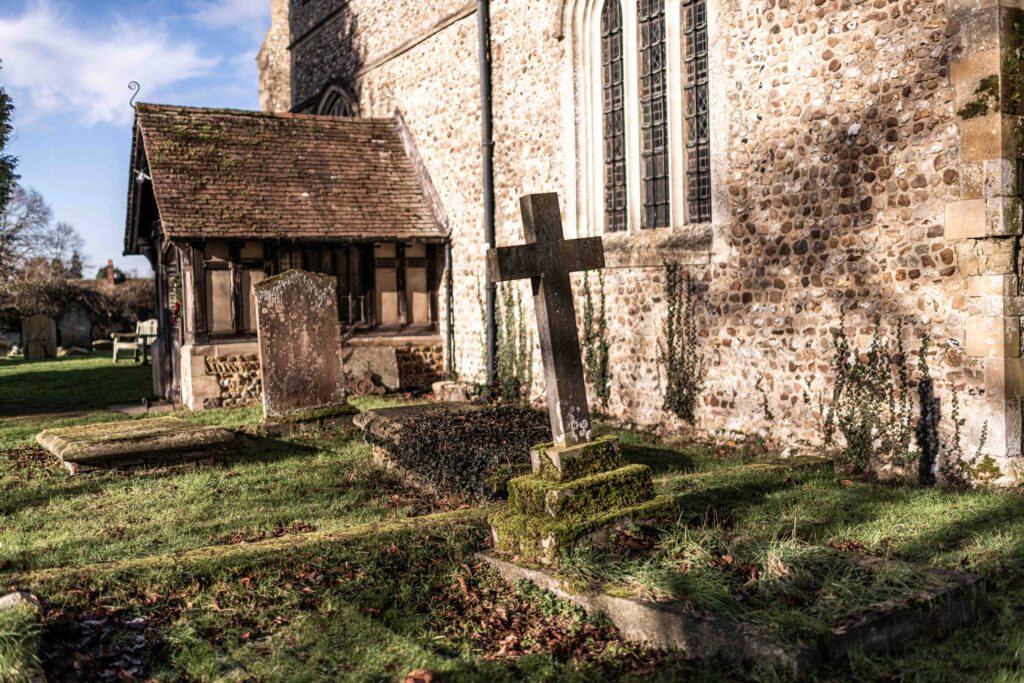
The faculty jurisdiction covers every parish church including its fittings and furnishings, and most other licensed places of worship, their churchyards (including detached churchyards) or curtilage land, any freestanding structures within the churchyard and the boundary walls, fences or hedges.
Why the faculty jurisdiction?
The faculty system is the ancient Church of England system providing a framework for giving permission for works to churches and in churchyards. As secular controls have developed for nationally-listed buildings of historic significance, the faculty system has also developed so that it can function as an equivalent to listed building controls. This means that works and changes to churches are dealt with in a system that recognises the primary function of churches as local centres of worship and mission. The faculty system applies to both listed and unlisted churches. The involvement of the Diocesan Advisory Committee (DAC) allows parishes to have expert advice free of charge as proposals are being developed and planned.
The faculty jurisdiction means that internal changes to church buildings do not need Listed Building Consent from your local council. Any external changes – no matter how big – may still need planning permission.
Exceptions
There are a number of categories of work which do not need a faculty:
- Minor Matters – see national List A (no permission needed) and List B (permission needed from the Archdeacon following light-touch DAC consultation). In this diocese there are some Minor Matters Additional Matters within List A or List B;
- Temporary Reordering – a licence from the archdeacon gives permission to experiment with reversible changes to layout and furniture;
- Churchyard Memorials – while the Chancellor has jurisdiction over churchyards, parish priests have delegated power to authorise memorial stones conforming to the diocesan Churchyard Regulations.
- Note: Private applications for exhumation or reservation of a grave space/ashes plot require a faculty, but do not need Stage 1 advice from the DAC.
How does the system work?
Applying for a faculty is a 2-stage process:
- Stage 1 – The applicant provides details of the proposed works so that the DAC can give advice. This may simply be to support the proposals, or the DAC may suggest other options or amendments, or say that consultation is needed with other bodies.
- Stage 2 – Once the DAC has advised formally on the works, the applicant completes the faculty petition form and public notice. After the public notice period has been completed, the Diocesan Registrar notifies the Chancellor, the senior legal officer of the Diocese, that the application is ready for consideration. The Chancellor considers the application and, if all is in order, grants the faculty subject to any conditions.
Applying for a List B permission is similar but without the second stage. Once the DAC has given advice or reviewed the proposals and is content, the DAC Team will ask the archdeacon’s office to issue the permission.


What information does the DAC need?
For faculty and List B applications, it is important that you provide adequate explanation and documentation so that all those involved, within the PCC and wider parish as well as the DAC, the Registry and the Chancellor, plus any external consultees, can understand exactly what you are proposing to do based only on the documentation you have provided. The type of documentation you need to provide will depend on the nature of the works or project. To find out what information you need for specific types of project, see the relevant section below. Once you have the information together, you are ready to make an application via the DAC part of the online portal, see below for more details.
Repairs
The DAC needs to see what work is being done (scope/extent) and how (materials/methods/health and safety and other provisions). The Quinquennial Inspection report (QI report) identifies where repairs are needed but does not cover these details. The PCC also needs to know this information, both to ensure the quotations it obtains are on a comparable basis to ensure best value and to ensure that the work will be done safely and in the right way by a qualified and insured contractor. Normally the church’s quinquennial inspector or another architect or surveyor should be engaged to specify the works, deal with tenders for larger projects, ensure the appropriate form of contract is used, oversee the works on site and sign them off when completed. See the DAC advice leaflet on Professional Advisers for more information.
Specialist works
For specialist works such as heating, lighting and organ repairs, it may be appropriate to obtain quotations with full proposal details from specialist contractors. Specialists should always have any relevant professional accreditation (where applicable, this must be for non-domestic/commercial work rather than only for domestic/householder work) and minimum £10m public liability insurance cover, as well as an appropriate level of professional indemnity cover.
Plans, photos and description
In all cases, it is important to provide before-and-after photos, location plans and a description of the works so that everyone is clear what is involved.
Drawings
For new works including new facilities, extensions, works of art, and for details of repairs, drainage works, etc., drawings will be needed as well as a specification and schedule of works.
Using volunteers for building works
This checklist is intended for use in the case of applications requiring a faculty and faculty conditions:
- The project shall be under the control of the PCC as the responsible body, even if it concerns work being proposed by a PCC subcommittee or group such as bell ringers
- The scope of work to be undertaken by volunteers shall be clearly set out in writing
- The PCC should have regard to the published guidance of the church insurer and any specific insurer requirements
- A risk assessment should be undertaken, documented and its recommendations agreed with all volunteers
- Where work is undertaken by volunteers which is part of contract works or otherwise directly affects the fabric or fittings of the church,
- The work to be undertaken by volunteers shall be noted in any relevant contract;
- The work undertaken by volunteers shall be supervised by the contractor (if relevant) and approved when complete by the contractor or project architect or surveyor.
DAC online applications
Please use the online portal to make your application for a faculty, a List B matter or where you are not sure what permission may be needed. Everything relating to your application will be available in one place and the User Guide and portal pages will take you through the process stage by stage. A User Guide is available to take you through using the DAC section of the Portal. When you reach Stage 2 and need to fill in the formal application form (faculty petition form) you may want to refer to the Checklist, which is available under the list of Forms for the case on the Portal at the relevant stage, to make sure you have all the information you need at hand.
Public Notices for current applications
Under Rule 9.9 of the Faculty Jurisdiction Rules 2015, some faculty applications must additionally be displayed on our website. For the majority of cases, public notices should be displayed on your church website, village website, local Facebook group or on A Church Near You.
Current applications under Rule 9.9
Rule 9.9.—(1) This rule applies where a petition relates to works that involve:
(a) demolition of a listed building;
(b) alteration to or the extension of— (i) any part of a grade I or II* listed building, or (ii) the exterior of a grade II listed building to such extent as would be likely to affect its character as a building of special architectural or historic interest; or
(c) demolition affecting the exterior of an unlisted building in a conservation area.
Current applications under Rule 9.9.
NONE