
As a diocese we see racial justice as part of our mission as the Church. It is part of our participation in God’s Kingdom work and consequently, this work belongs to all of us.
Racial justice and why it matters
The good news that Jesus proclaimed was that the Kingdom of God had come to earth; to bring healing, reconciliation, restoration and justice. Jesus taught us to pray, “Your Kingdom come, your will be done, on earth as in heaven”, and sent his Church to live and proclaim this good news throughout the world.
As a result, the work we undertake for justice – including racial justice – is never about following an external agenda imposed upon us. All justice is God’s justice. All justice is part of God’s Kingdom and the good news of Jesus. Therefore, as a diocese, we see racial justice as part of our mission as the Church. It is part of our participation in God’s Kingdom work, not something peripheral to it.
Consequently, this work belongs to all of us. Together, we are called to listen well, speak honestly, learn from one another, and help build a Church that more fully reflects the Kingdom that Jesus announced and embodied.
Baselining Survey
Understanding where we are is an important first step towards knowing where we need to go. Our baselining survey is an 8-question multiple-choice survey open to anyone in our Diocese who has any level of involvement with the Church.
With a good number of responses so far, it is helping us build an initial picture of the people, experiences, and perspectives across the Diocese. The results will help inform our understanding of where we are and help us listen well so we can move forward in the right direction.
If you have any involvement with the church (including attendance) in the Diocese of St Albans, we would appreciate it if you could take part, thank you.
Research into Ministry Vocation for Global Majority Heritage Individuals in the Diocese of St Albans
The Youthscape Centre for Research is undertaking a research project exploring experiences of vocation and ministry pathways for Global Majority Heritage (GMH) individuals within the Diocese of St Albans, with particular focus on the obstacles that may prevent such individuals from pursuing lay / ordained ministry.
This project is being supported by grant funding from the Diocese and seeks to better understand how GMH individuals experience vocation, discernment, and pathways into ministry, as well as how churches and diocesan structures can best support those exploring God’s call to address any existing barriers or challenges.
Over the coming months, members of the Youthscape research team may contact churches across the Diocese to invite participation in interviews, conversations, or other research activities. The research will take place across two phases beginning in September;
Phase 1 will include surveys / interviews with GMH individuals who are currently in or have left lay / ordained ministry, those who started pursuing ministry but did not complete the process, and those who were in some way discounted before pursuing a route into ministry. Interviews will take place with a member of the Research Team online or in-person, but a survey will be also available to offer a way of partaking in the research with full anonymity.
Phase 2 will include 3 case studies of church communities from across the Diocese. The purpose of these case studies will allow the Research Team to gain a greater understanding of GMH individuals’ experiences, inclusion, accessibility, alongside culture and structures. Within these case studies, the Research Team will focus on the experiences of young adults, and this will include observations, interviews, and looking at church literature. This phase will finish with the co-creation (between participants, the Research Team, and the Racial Justice Officer) of actionable recommendations for the Diocese.
Participation in the research is entirely voluntary. The project is being conducted independently by the Youthscape Centre for Research and is subject to appropriate ethical review, safeguarding requirements, and data protection legislation.
If you or your church would be interested in hearing more about the project or potentially participating, please contact the Youthscape research team: research@youthscape.co.uk
We are grateful to all those who are willing to contribute to this important piece of research and please do keep an eye on communications from the Youthscape Centre for Research in the coming weeks.
Diversity Data Project
The National Church is running an initiative asking clergy to update their diversity data in the People System. The project allows the Church of England to have a more data-driven approach to equality, diversity and inclusivity (EDI) and to tackle the underlying drivers of imbalance in the organisation. Only by being more aware of the unique challenges and opportunities faced by different groups within our church can we effectively plan for the future, provide effective pastoral care and address gaps in our resources or services as an organisation.
So far, 30% of clergy have updated their data. If you are yet to do this, please download the following document and follow the process on the page two update your diversity data. Thank you.
Racial Justice Grants Scheme
We want to encourage, support, and celebrate local initiatives that contribute to a more welcoming, participatory, and intercultural church.
The Racial Justice Grants Scheme provides funding for projects that help build belonging, strengthen participation, and share stories of what God is already doing across our diocese. The scheme offers small grants (up to £250) and large grants (up to £1,000).
If there is work going on in your church or parish community which you think could benefit from this funding, please apply here.
While we prefer to offer grants directly to parishes/churches, we recognise that not all initiatives are directly linked with parishes and churches. We will consider the nuance of each grant on a case-by-case basis.

Racial Justice Action Group
The Racial Justice Action Group (RJAG) is at the heart of the Diocese’s commitment to advancing the participation of those of Global Majority Heritage/UK Minority Ethnic Heritage in making sure that their voice is fully heard; to becoming a consciously inclusive Diocese that fully reflects the diversity of its population; and to ensuring that clergy and laity of any background can minister anywhere in the Diocese without discrimination or hindrance.
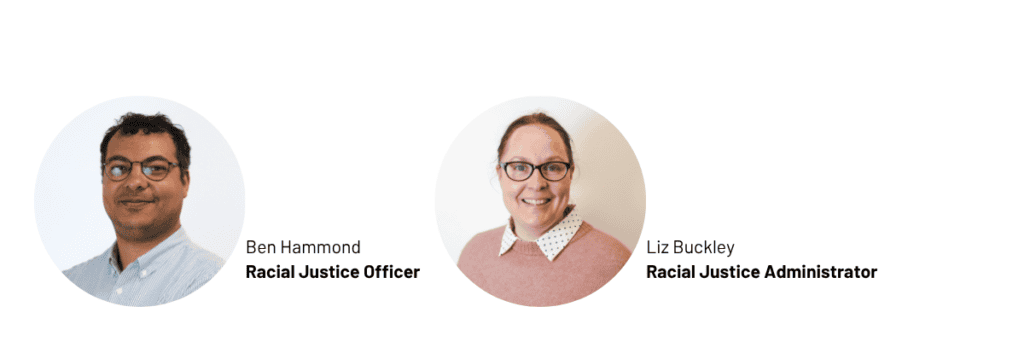
Meet the team
Get in touch with your stories or queries
Read the latest updates, stories, events, and announcements relating to racial justice work across the Diocese.
If you have a story, or would like to chat to us about a project, service or event taking place where you are, or have any questions, please be in touch.