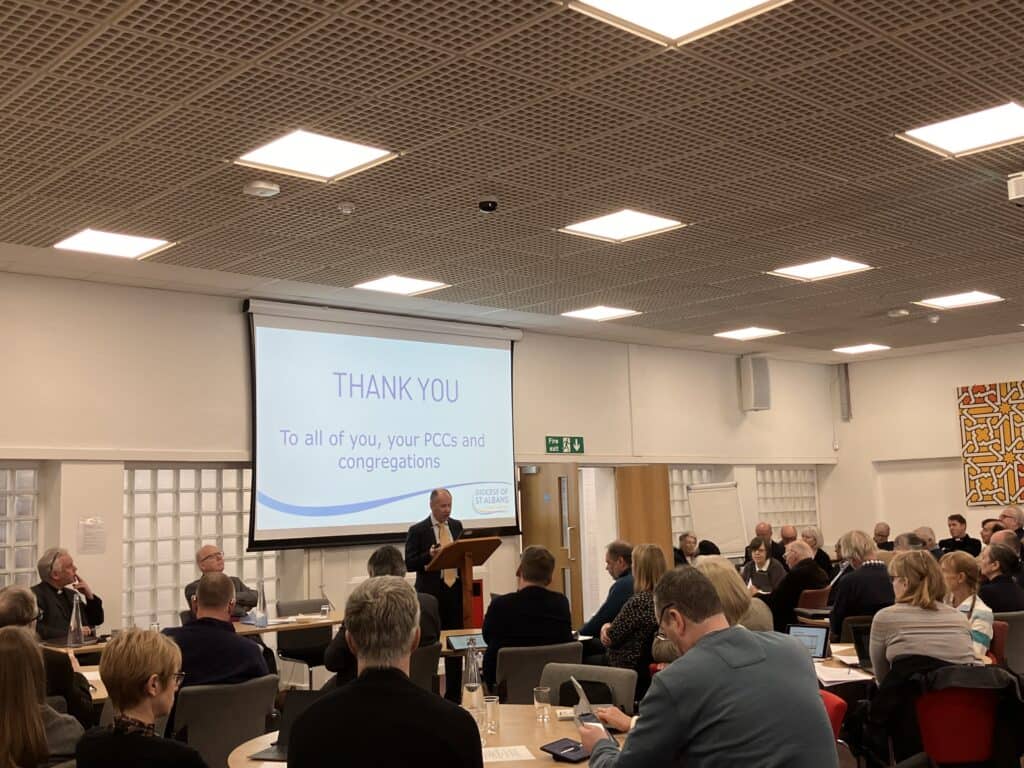
Diocesan Synod is the democratically elected decision-making body of the diocese. Its membership is comprised of both clergy and laity, representing the 20 deaneries in the diocese. Synod members are elected for a period of three years, beginning on 1st August in the year of their election – see Diocesan Synod Constitution for full details.
Membership
House of Bishops
The Bishop of St Albans (President); The Bishop of Bedford; The Bishop of Hertford.
House of Clergy
Chair: The Revd Will Gibbs
Deputy Chair: The Revd Kate Pearson
Members The Dean; the Archdeacons; the Proctors; representatives (as nearly as possible 100) elected by the Houses of Clergy of the Deanery Synods.
House of Laity
Chair: Canon Peter Adams
Deputy Chair: Ms Kerry Smith
Members The Chancellor of the Diocese; The Chair of the Board of Finance; The Chair of the Diocesan Advisory Committee; The Diocesan Representatives in the House of Laity of the General Synod; Representatives (as nearly as possible 100) elected by the Houses of Laity of the Deanery Synods.
Bishops Nominations (up to ten nominations which may be of the clergy or the laity): none
Co Options (up to 5 by each of the Houses of Clergy and Laity): none
Registrar of the Synod: Mr Jon Baldwin
Secretary of the Synod: Mr David White
Three meetings are normally held each year – on Saturdays in March, June and October.
Dates of Future Synods
2026
Saturday 14 March
Saturday 13 June (online)
Saturday 17 October
What Does the Diocesan Synod Do?
The Diocesan Synod:
- Considers matters concerning the Church of England and makes provisions for such matters in relation to the diocese.
- Considers and expresses its opinion on any other matters of religious or public interest.
- Advises the Bishop on any matters on which he may consult the Synod.
- Considers and expresses opinion on any matters referred to them by the General Synod – the ruling body of the Church of England – and in particular approves or disapproves provisions referred to Diocesan Synod under Article 8* of the General Synod Constitution.
*Article 8 of the Constitution of the General Synod provides that certain kinds of legislation may not receive the final approval of the General Synod unless they have first been approved by the majority of Church of England diocesan synods.
How does it function?
Information regarding the workings of Synod is sent to all newly elected Synod members and can be viewed here.
Sub-Committees of the Diocesan Synod
There are two main sub-committees of the Diocesan Synod:
The Bishop’s Council
This statutory body is established under the Synodical Government Measure 1969. It acts as the Standing Committee of Synod and carries on its work between sessions. It advises the Bishop on matters where he seeks guidance and has an important role in the formulation of diocesan policy. Members of Bishop’s Council are regarded as ‘quasi trustees’ and share with DBF members responsibility to the Charity Commission.
Bishop’s Council also takes on the statutory role of Diocesan Mission and Pastoral Committee. The Council receives regular reports from other bodies and responds to national consultations and initiatives.
Full details about Bishop’s Council, including a link to its constitution are available here. The Council currently meets four times a year
Nominations Committee
The Nominations Committee was formed in 2024, alongside the process for elections to boards and committees taking place that year. Their role is to advise on nominations, co-options and elections and to promote vacancies on diocesan bodies so as to encourage diversity and breadth of representation.
Membership:
Ex Officio: The Bishop of Bedford, Dr Tim Coulson, Canon Peter Adams, The Revd Will Gibbs
Elected: The Revd Canon Lucy Davis, Ms Pauline Kendall
Co-Opted: The Revd Jenni McQuaid, Dr Louis Spring
In Attendance: The Diocesan Secretary, The HR Business Partner, The Governance and HR Operations Manager