
Introducing the Diocese of St Albans
The Diocese of St Albans is part of the Church of England and home to more than 1.9 million people. It includes Bedfordshire, Luton, Hertfordshire and parts of the London Borough of Barnet.
The Diocese was founded by an Order in Council in April 1877, implementing the Bishopric of St Albans Act, passed by Parliament two years earlier.
It ranges from small rural communities to urban centres like Luton, Bedford, Watford and Hemel Hempstead and includes suburban areas on London’s outer reaches.
These communities are served by 340 parishes, 400 churches, and 137 church schools and academies.
Across the Diocese are many thousands of Christians who seek to express their faith in their daily lives – in their families and at home, at their place of work and in their local communities.
Around 300 clergy (including stipendiary, non-stipendiary and those with Bishop’s Licence), 225 licensed Readers and 180 with Permission to Officiate, and other lay ministers offer spiritual and pastoral care, and help people to explore the significance and challenge of the Christian faith in today’s world.
The Diocese is overseen by the Bishop of St Albans, whose ‘cathedra’ or chair, is in St Albans Cathedral. He is supported by the Bishops of Bedford and Hertford, and by three Archdeacons.
For more information about the life and activities of the Diocese of St Albans – including links to many parish websites, visit www.stalbansdiocese.org.
What is Diocesan Synod?
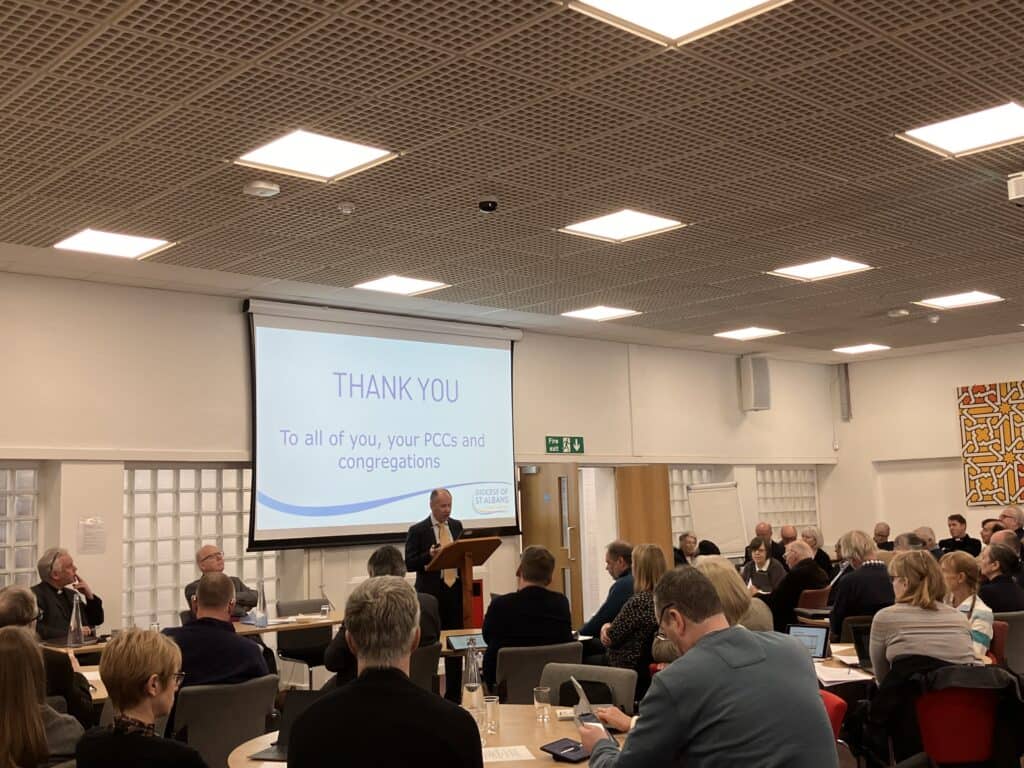
Diocesan Synod is the democratically elected decision-making body of the Diocese. Its membership is comprised of both clergy and laity, representing the 20 deaneries in the Diocese. Synod members are elected for a period of three years, beginning on 1 August in the year of their election. The current Triennium ends on 31 July 2027.
Three meetings are normally held each year – on Saturdays in March, June and October. These are held either at in person at a venue within the diocese or online. An Agenda Committee keeps the format, timing and location of Synod under review.
Diocesan Synod:
- Considers matters concerning the Church of England and makes provisions for such matters in relation to the Diocese.
- Considers and expresses its opinion on any other matters of religious or public interest.
- Advises the Bishop on any matters on which he may consult the Synod.
- Considers and expresses opinion on any matters referred to them by the General Synod – the ruling body of the Church of England – and in particular approves or disapproves provisions referred to Diocesan Synod under Article 8* of the General Synod Constitution.
*Article 8 of the Constitution of the General Synod provides that certain kinds of legislation may not receive the final approval of the General Synod unless they have first been approved by the majority of Church of England diocesan synods.
How does it function?
The Synod consists of three Houses: Bishops, Clergy and Laity. The Bishop of St Albans is the President of the Synod. From time to time, when a particular need arises, meetings of the individual Houses are held. The Houses meet together for the meetings of Synod.
The work of the Synod is normally carried out through Diocesan Boards and Committees most of which are elected from 1st January in the year following Diocesan Synod elections. They report regularly to the Synod about their work, and the Synod approves their annual expenditure as part of the Diocesan Budget.
The two bodies that relate most closely to the Diocesan Synod are the Bishop’s Council – the Standing Committee of the Synod – and the Diocesan Board of Finance, which is the Synod’s financial executive.
The other main boards of the Diocese are the Board for Mission and Ministry and the Board of Education.
How is the agenda agreed and circulated?
The agenda for Diocesan Synod meetings is drafted by the Agenda Committee of the Bishop’s Council.
Synod members receive a preliminary notice six weeks before each meeting, which gives dates by which new business and questions must be submitted. Agenda papers are circulated electronically three weeks before each meeting.
Non-members who wish to attend the meeting need to notify the Diocesan Secretary in advance so that they can be included in the attendance lists.
What business does it cover?
The Synod’s business each year includes:
- A Presidential address, delivered by the Bishop of St Albans at each Synod.
- The Diocesan Common Fund budget for the coming year; the receipt and discussion of the accounts of the Diocesan Board of Finance for the past year; and the approval of stipend levels – the amount paid to clergy – for the coming year.
- Receipt and discussion of the Annual Reports of Diocesan boards and committees.
- Questions raised by members of the Synod – these should be sent in writing to the Diocesan Secretary at least 14 days before a meeting of Synod.
- Matters raised by Deanery Synods.
- Matters referred by the General Synod, including draft legislation.
- Motion and presentations by Diocesan boards and committees.
The procedures of the Synod and its method of functioning are regulated by its Standing Orders. A copy of these is available here.
Who are the members of the Diocesan Synod?
House of Bishops:
The Bishop of St Albans (President of the Synod)
The Bishops of Bedford and Hertford
Any other bishop working in the Diocese, if nominated by the President.
House of Clergy:
The Dean of St Albans
The Archdeacons (St Albans, Hertford, and Bedford)
The clerical members from the Diocese on General Synod
Up to 100 Members elected by the houses of clergy from deanery synods in the Diocese
Up to five members co-opted by the house of clergy of the diocesan synod.
The Chancellor of the Diocese (who, if not ordained, is a member of the House of Laity)
The Chairmen of the Diocesan Board of Finance, Diocesan Board of Education and Diocesan Advisory Committee (who, if not ordained, are members of the House of Laity)
House of Laity:
The Lay members from the Diocese on General Synod.
Up to 100 Members elected by the houses of laity from deanery synods in the Diocese
Up to five members co-opted by the house of laity of the diocesan synod.
In addition, the Bishop of St Albans may nominate ten additional members of Diocesan Synod, who may be clergy or laity.
The Houses of Clergy and Laity meet separately to elect a chair and vice chair at the first meeting of the Synod in each three-year period, or triennium. The Chairs of the houses of Clergy and Laity serve as Vice-presidents of the Synod.
Officers of the Synod
Secretary – The Diocesan Secretary, Mr David White, Holywell Lodge, 41 Holywell Hill, St Albans, AL1 1HE. 01727 854532 dwhite@stalbans.anglican.org
Legal Adviser – The Diocesan Registrar, Mr Jon Baldwin, Winkworth Sherwood LLP, Arbor, 255 Blackfriars Road, London SE1 9AX stalbansregistry@wslaw.co.uk
Documents relating to the next or most recent meeting of Synod can be accessed here.