
Over the past couple of years several people have expressed their concern that if they change their heating system, then their church is more likely to be damp. Finding the answer to that question has taken some time, and I am grateful that an archaeology student, Isobel Garman, spent a chunk of her summer wading through about 800 quinquennial inspection reports to help us to find the answer, help identify the common causes of damp, and whether or not our churches are getting damper.
What are the causes of damp in our churches?
We undertook a very high-level review of the most common causes of damp identified in the QIs, interpreting the architect’s words. 288 churches were identified as having damp and there were 184 QIs where it was simple to identify the primary cause. The main reasons are listed in the table below.
| Main cause of damp | No. of churches |
| Rainwater goods | 66 |
| Construction | 60 |
| Roof | 17 |
| Drainage | 16 |
| Ground levels | 12 |
| Condensation | 4 |
| Services | 2 |
| Vegetation | 2 |
| Rising damp | 2 |
| Design | 1 |
| Water table | 1 |
| Flooding | 1 |
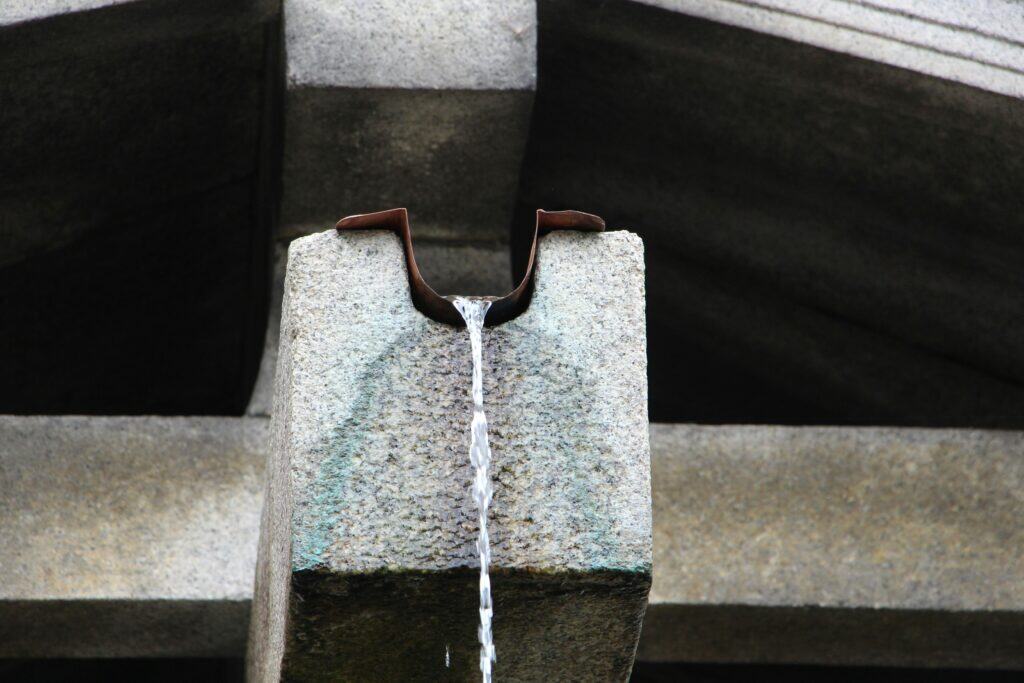
As you can see, problems with the rainwater goods were the most frequently cited cause. When combined with ground level drainage problems these are responsible for around 45% of damp issues in churches. It may not be a dream task but taking a walk around your church in heavy rain and looking for any problems with the guttering and drainage, and noting where water is splashing back on to the building may save substantial costs in the medium-long term.
The construction category accounts for around one third of the damp issues, but covers a host of issues including inappropriate materials having been used for past repairs (e.g. concrete render, non-breathable plaster and other finishes), and deterioration of the structure such as through cracks developing, or pointing and other elements deteriorating.
External ground levels and vegetation were also frequently noted. One of those is much easier to resolve than the other.
Managing ventilation as a means to help manage the damp was raised in around 10% of the reports. When it comes to using it to try and manage damp it’s not as simple as just leaving the ventilators open all the time. There will be times, particularly in spring and autumn where this will result in moist air being brought into the building which may make the damp problems worse rather than better, particularly when the air outside is warmer than the air inside the church. As it enters the building the air will cool, and if there are cold surfaces this may result in condensation forming and becoming part of the problem.
For the remaining 104 churches with damp, either the cause was not specified, or there were multiple causes and picking a single one as the primary cause was not useful. I think the learning from this is potentially to ask your professional advisor to suggest the possible cause(s) of any damp they identify.
Has the prevalence of damp increased over time?
As well as the latest QI reports Isobel also looked at our oldest electronically held QI reports to understand whether there has been an increase in the prevalence of damp reported. It is sad to report that there has been an increase in the level of reporting of damp, with 79% of the most recent QI reports mentioning damp, compared to 36% of the historic reports. It is not clear what the reason for this is. It may be that there is greater reporting of damp now than there was in the late 1980s and early 1990s when the historic reports were written, frequently on a typewriter. Certainly the reports now tend to be considerably longer. It may also be the case that historically a certain level of damp was accepted and not considered noteworthy, but it’s a mystery I doubt we’ll be able to get to the bottom of.
So does the heating fuel make a difference?
The short answer is no. We assessed 365 current QI reports with the following results:
| Heating Fuel | No. of churches | % with damp reported |
| Gas | 202 | 76% |
| Oil | 45 | 78% |
| Electricity | 118 | 76% |
We found no increase in the likelihood of a church having damp if the church had an electric ‘heat the people’ heating system compared to a gas or oil-fired space heating system. We have excluded calor gas and LPG heated churches from the table for readability.
Does the type of heat emitter make a difference?
We have also looked at whether there is any significant difference in the presence of damp with different types of heat emitter in churches. In general there was not a great deal of variation, however it was notable that only 40% of churches with underfloor heating had damp identified. This may be because the buildings with underfloor heating are used more, and because underfloor heating is slow to respond it will normally be run relatively constantly to maintain a temperature. At the other end of the scale, churches with fan convectors that can potentially rapidly warm the air mass within a building had the greatest prevalence of damp reported, as shown in the graphic below.
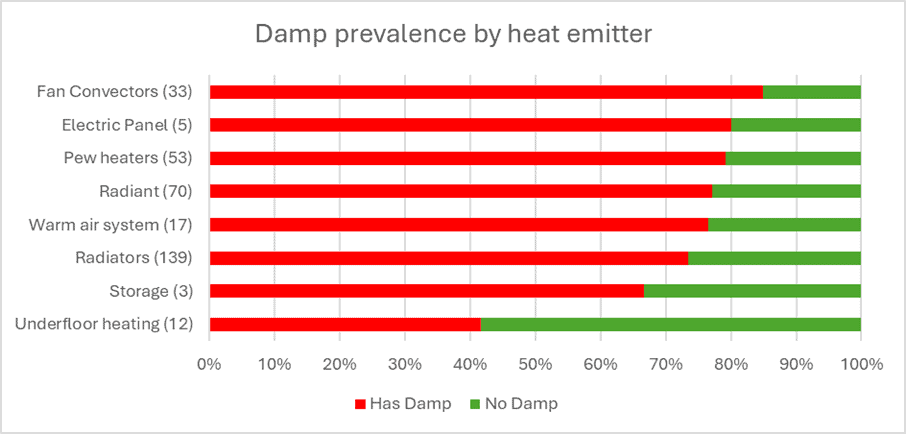
In some ways the results are a surprise, as a space heated church with higher internal air temperatures may be more likely to mask the appearance of damp, however the counterpoint is that warm air can carry more moisture than cold air, so its presence within the building may serve to draw the moisture out of the fabric making damp more likely to appear. Moisture movement in buildings is very complicated! One thing that shouldn’t be assumed is that a fan convector will increase the likelihood of your church being damp as looking back at the causes of damp, only around 2% identified condensation as the main cause. It’s an area which potentially needs more research if anyone has the time and inclination and would like to volunteer?!
Key take aways
Keep an eye on your guttering and drainage, particularly in heavy rain. Small actions now may save heartache and expenditure in the future.
There is no obvious increase in the likelihood of damp being present in a building that is electrically heated compared to one with a traditional space heating system.
Further advice…
What is maintenance and why is it important? – The Diocese of St Albans
Roof maintenance – a good hat! – The Diocese of St Albans
Rainwater goods and drains – The Diocese of St Albans
Does the shoe fit? – The Diocese of St Albans
Two Churches; Both Alike in Repairs – The Diocese of St Albans